
Not a homicide? Victim dies two weeks after skull is cracked with a two-by-four in a random assault downtown Chilliwack
40-year-old Kevin Procure charged with aggravated assault in connection with incident caught on multiple CCTV videos
April 17, 2026
If someone hits another person in the head with a two-by-four with such force it cracks the victim’s skull, that usually falls under section 268 of the Criminal Code: aggravated assault.
If said victim dies in the subsequent days, that now would likely fall under sections 234 or 235: manslaughter or second-degree murder.
If, however unlikely it might be, something else happens to the victim in between the assault and his death, the causal chain may be broken taking homicide off the table.
This is the highly unusual circumstance in what allegedly happened to 37-year-old Dwight Nelson at the hands of 40-year-old Kevin Procure two months ago in Chilliwack. A prolific offender, Procure was in provincial court in Chilliwack on Tuesday (April 14, 2026) facing a Crown bail hearing, complicated somewhat by the fact that he was already out on bail for another criminal charge when the alleged assault happened.
In the early hours of Feb. 21, 2026, Nelson was walking along Railway Avenue near Young Road pushing a bicycle with a friend, James Gunn. The two witnessed a male chopping up pallets behind a business. Nelson told Gunn, “That’s Kevin,” Crown counsel Michelle Wray told the court.
Procure allegedly yelled at them that the bike Nelson was pushing was his and it was stolen. Nelson replied that, no, it was not. Procure allegedly then swung a two-by-four piece of lumber like a baseball bat. Gunn ducked and Nelson was hit in the head. He was knocked to the ground, left bleeding from his nose, his ears and his eyes, the court heard. They went to Chilliwack General Hospital but the triage process was taking too long for Nelson who said he just wanted to lay down, so he left the hospital.
Two days later, still bleeding from his ears, he went back to the hospital where a CT scan revealed a subdural hematoma (bleeding on the brain) and a skull fracture radiating from the base of the skull over the top of his head to his orbital bone (eye socket). Despite this serious injury, Nelson declined being admitted. He was given ibuprofen and returned to his home, which was a makeshift structure somewhere in the woods in Chilliwack where he lived with his girlfriend.
Ten days later on March 5, Wray told the court that Nelson hit his head on a homemade chandelier in the structure and was left writhing in pain on the ground. His girlfriend called Gunn who took Nelson back to Chilliwack General Hospital. With significant swelling on the brain, Nelson was medevaced to Royal Columbian Hospital where he was pronounced dead.
Infrequent use of tertiary grounds
Chilliwack RCMP issued a news release after charges were laid against Procure, in part to point out that the arrest was made possible by tips from local business and other members of the community.
While the footage isn’t great and the sound in one video is terrible, the court saw CCTV footage from multiple businesses on Railway Avenue and Young Road, one that actually shows the assault. In another, voices can be heard and the thumping sound of wood hitting Nelson’s head can be heard.
The Crown's case will be focused on identity, as in, whether it can be proven beyond a reasonable doubt that Procure is the attacker.
The charge he faces is aggravated assault because his death on March 6 was not causally linked to the injury on Feb. 21 especially with the injury sustained on March 5. So, somewhat strangely, Nelson’s death is not directly relevant to the case against Procure. Wray told Judge Michael Fortino that while Nelson died “as a result of these injuries as well as a subsequent blow to the head,” the prosecution is not alleging that Procure is legally responsible for Nelson’s death.
The hitting of his head on the chandelier broke the chain of events from violence to death so the case is not a homicide. There is no middle ground between aggravated assault and manslaughter along the lines of “assault causing death but not quite homicide.”
Regardless, the charge is extremely serious and comes with a sentence up to 14 years in jail. Wray suggested if Procure pleaded guilty that could be as low as three years or as high as five if it goes to trial.
In asking for him to be denied release on bail, Wray told Judge Fortino she was relying on secondary and tertiary grounds. When a judge decides on whether an accused person should be released on bail in Canada, they must consider three grounds under section 515(10) of the Criminal Code:
- Primary grounds: To ensure the accused will attend court.
- Secondary grounds: To protect public safety and prevent further offences or interference with justice.
- Tertiary grounds: To maintain public confidence in the justice system, considering the seriousness of the offence, strength of the evidence, and potential sentence.
More simply put: attendance, protection, and confidence, the latter of which is infrequently used given the ambiguity around what or what does not maintain confidence in the administration of justice.
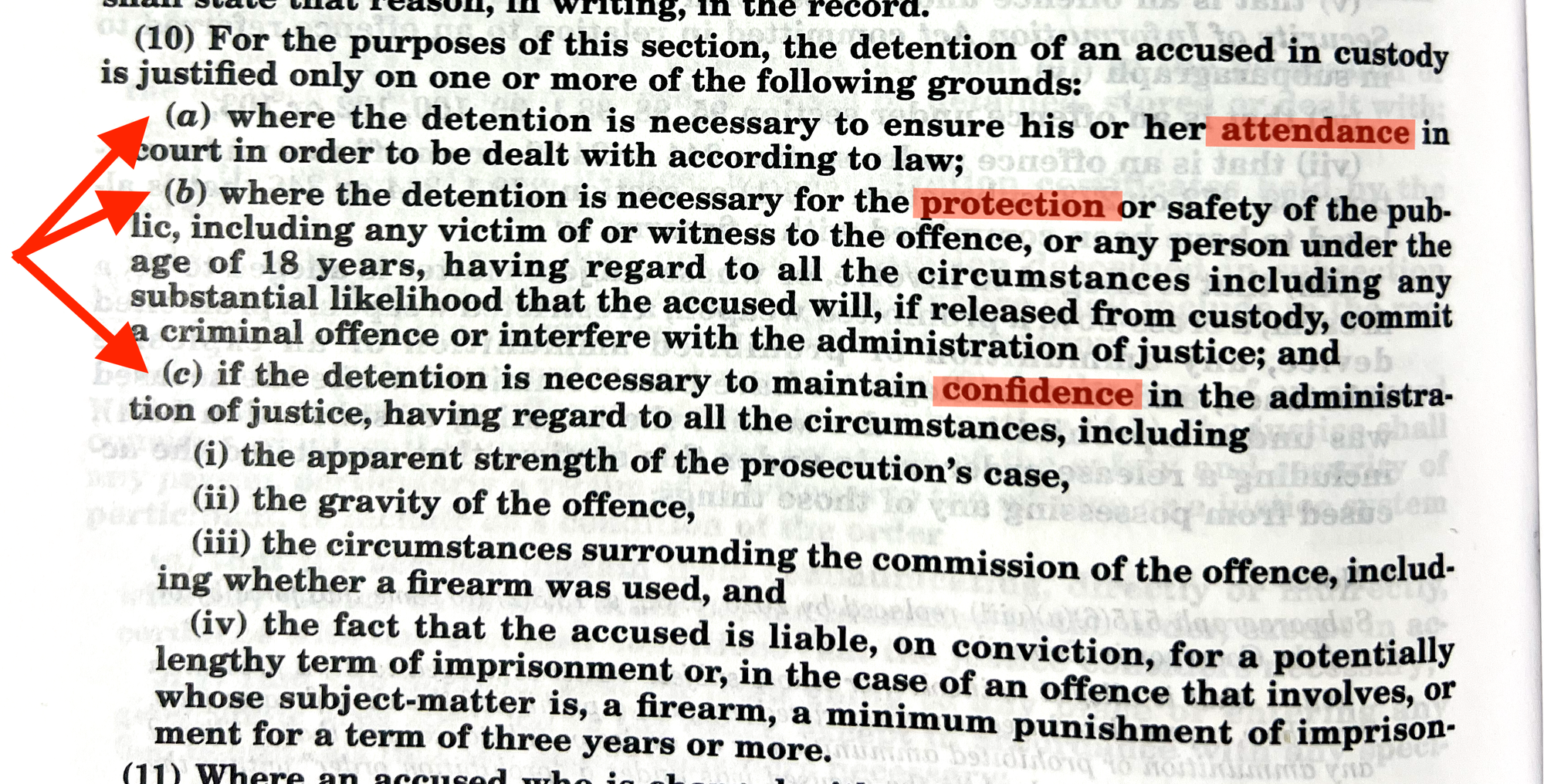
Wray argued that this was an “extremely violent offence” that met the test outlined in a 2015 Supreme Court of Canada decision R. v. St. Cloud addressing tertiary grounds.
“The public is very concerned about random acts of violence,” Wray said.
Defence counsel Chris Terepocki said that Procure suffers from serious alcoholism and their release plan involved rehabilitation with his acceptance at Joshua House in the Chilliwack River Valley.
He said this was a strong release plan and that while Procure was in a reverse onus position “I believe he has met that.”
Wray responded only that the residents of Joshua House also represent members of the public so the tertiary grounds still apply.
Procure has an extensive criminal history with a large number of so-called “K” files, which represent cases of intimate partner violence. On March 30, he was sentenced to 16 days jail for a K file that involved seven breaches of release orders and probation. That day he also faced an application to revoke bail for a charge of assault from Nov. 26, 2025 followed by two breaches in February 2026.
On the aggravated assault file, Judge Fantino did not allow the release on bail and issued a detention order. Procure remains in custody, next due in court on April 21 to fix a next date.
-30-
Want to support independent journalism?
Consider becoming a paid subscriber or make a one-time donation so I can continue this work.
Paul J. Henderson
pauljhenderson@gmail.com
facebook.com/PaulJHendersonJournalist
instagram.com/wordsarehard_pjh
x.com/PeeJayAitch
wordsarehard-pjh.bsky.social