10 years into B.C.'s toxic drug crisis death rates are lower but five people still die every day: Who is dying of what, where, when & how?
A demographic bullseye: A middle-aged man smoking fentanyl in a private residence in Prince George in the days following Welfare Wednesday
There is no question the number of B.C.’s toxic drug deaths are a daily tragedy as the crisis continues with five people dying every day on average as the province hits the 10-year anniversary of the public health emergency.
The number and rate of deaths in some of the hardest hit communities, however, dropped precipitously from a peak in 2023 in 2024, again in 2025, and so far in 2026.
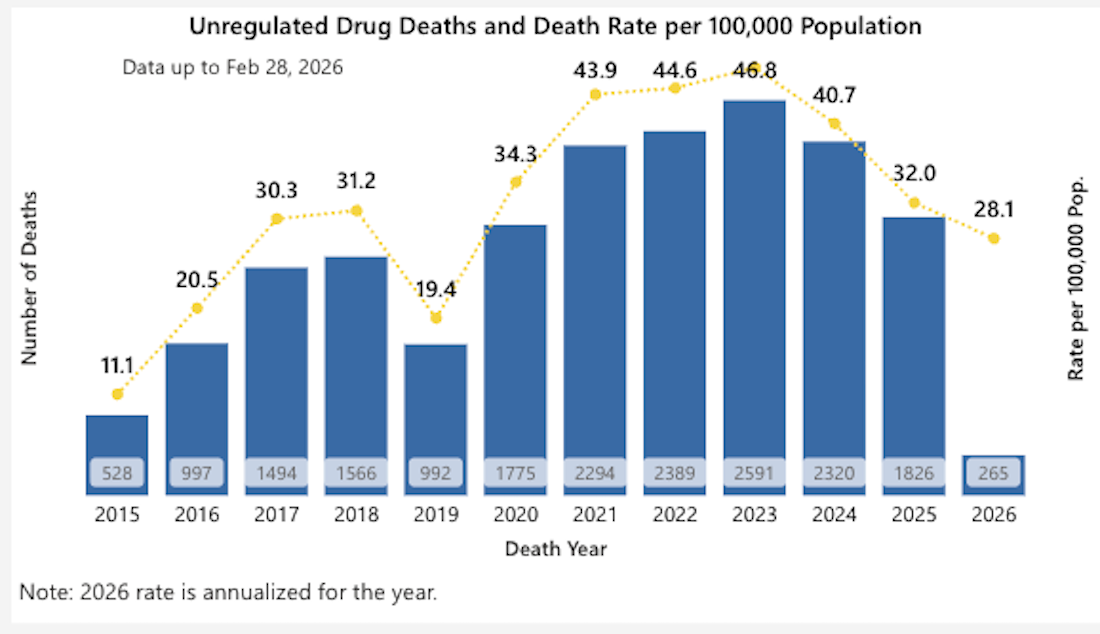
There have been 265 unregulated drug deaths in the province in the first two months of 2026, according to the monthly reports from the BC Coroners Service. While every death is a tragedy and the public health crisis still lingers, that puts the province on pace for 1,590 deaths, the fewest in a year since pre-pandemic in 2019. The 1,826 deaths in 2025 itself was 20 per cent decline from the 2,320 deaths in 2024, which itself was lower than 2023 (2,591), and 2022 (2,389).
Who is dying of what, when, where and how?
Looking over all the numbers provided monthly by the BC Coroners Service in their unregulated drug death report, it is a demographic bullseye to pick a person who is dying: A middle-aged man smoking fentanyl in a private residence in Prince George in the days following Welfare Wednesday
What is killing people?
The rates of deaths by homicide, suicide, MVI, and prescription drugs have all remained relatively unchanged in British Columbia between 2015 to 2024.
Suicide is the highest among those four modes of death at approximately 500 per 100,000, and has gone down slightly. Unregulated drug deaths on the other hand, went from below 500 in 2015 to a peak of more than 2,500 in 2023. In 2025, it was still higher than 2,000.
- Drug deaths by drug types relevant (numbers don't add up because some victims are found with multiple drugs in their systems):
- Fentanyl went from being found in 28.6 per cent of drug deaths in 2015 to 80.2 per cent in 2025
- Benzodiazepines are the newest problem rising from 4.6 per cent to 47.3 per cent
- Methamphetamines rose from 29 per cent to 52 per cent
- Cocaine is relatively unchanged at just under 50% per cent
- Alcohol and other opioids dropped in numbers
Who is dying?
The highest number of deaths are in the 40-to-49 age group followed by 30-to-39, while over the 10-year-period, men ranged between 75 per cent and 80 per cent of all deaths, at 78 per cent so far in 2026.
Where people are dying isn't what is seen on streets
Over the decade there was a slow rise in the location of deaths up to 65 per cent in private residence, and 14.5 per cent in another residence or public building and just 19 per cent outside.
Across B.C., the rate is 28.1 per 100,000 across B.C.
- By health authority so far in 2026 the rate per 100,000:
- Highest at 51.4 in Northern
- Lowest of 16.4 in Fraser Health
- Island 40.3, Vancouver Coastal 33.1, Interior 30.6
- By Health Service Delivery Area:
- Highest of 69 in Northern Interior followed closely by 68.9 in Kootenay Boundary
- Low of 7.5 in Richmond followed closely by 8.9 in North Shore/Coast Garibaldi
- 51.8 in Vancouver, 23.5 in Fraser East
- By Local Health Authority in 2024 (some data not available for all of 2025):
- Highest by far at 426.3 in Vancouver-Centre North (are that includes the Downtown Eastside) while second place is a distant 121.8 in Lillooet followed by 120.2 in Greater Campbell River
- Low of 5.3 in Fernie, 6.4 in Vancouver-Westside, 7.6 in Howe Sound
- Hope is 7th at 33.7, Abbotsford 42.7, Chilliwack 34.8, Agassiz/Harrison 34.9
When are they dying?
The number of deaths per year went from 528 in 2015 to 1,826 in 2025 with the worst year being 2023 and 2,591 deaths.
- April is the worst month, the fewest die in February
- Average number of unregulated drug toxicity deaths per day following income assistance payment day (Welfare Wednesday) from 6.0 so far in 2026 to 4.3 on other days of the year; 2025 6.1 and 4.8
How exactly are they dying?
Smoking has made up more than two thirds of all modes of consumption leading to overdose from January 2024 to February 2026.

-30-
Want to support independent journalism?
Consider becoming a paid subscriber or make a one-time donation so I can continue this work.
Paul J. Henderson
pauljhenderson@gmail.com
facebook.com/PaulJHendersonJournalist
instagram.com/wordsarehard_pjh
x.com/PeeJayAitch
wordsarehard-pjh.bsky.social