
Canada’s open-court principle is meaningless when those in charge treat journalists as irritating interlopers
Recent meeting of reporters from across Canada highlighted nationwide courthouse culture of secrecy about public information that the media has every right to access
June 22, 2026
Canada’s democracy in no small part relies upon the self-correcting mechanisms of free-and-fair elections, an unfettered judiciary, and independent media.
What the general public might be surprised to learn is that third pillar’s ability to share information about the second pillar relies upon nothing more than the whims and knowledge and experience of individual participants in that system. From court clerks up to B.C. Supreme Court Justices, almost no one who works at any level of Canada’s judicial system seems to know their responsibility to openness or the media’s right to be given public information to share with readers.
I recently took part in a meeting with dozens of journalists from across Canada who cover the criminal justice system and civil court from Newfoundland to the Northwest Territories and everywhere in between. (The only jurisdictions not represented at the meeting were Nunavut and Quebec.)
“Staff don’t know what they can or can’t do and the default is to not do anything,” a broadcast journalist from the Maritimes said at the meeting.
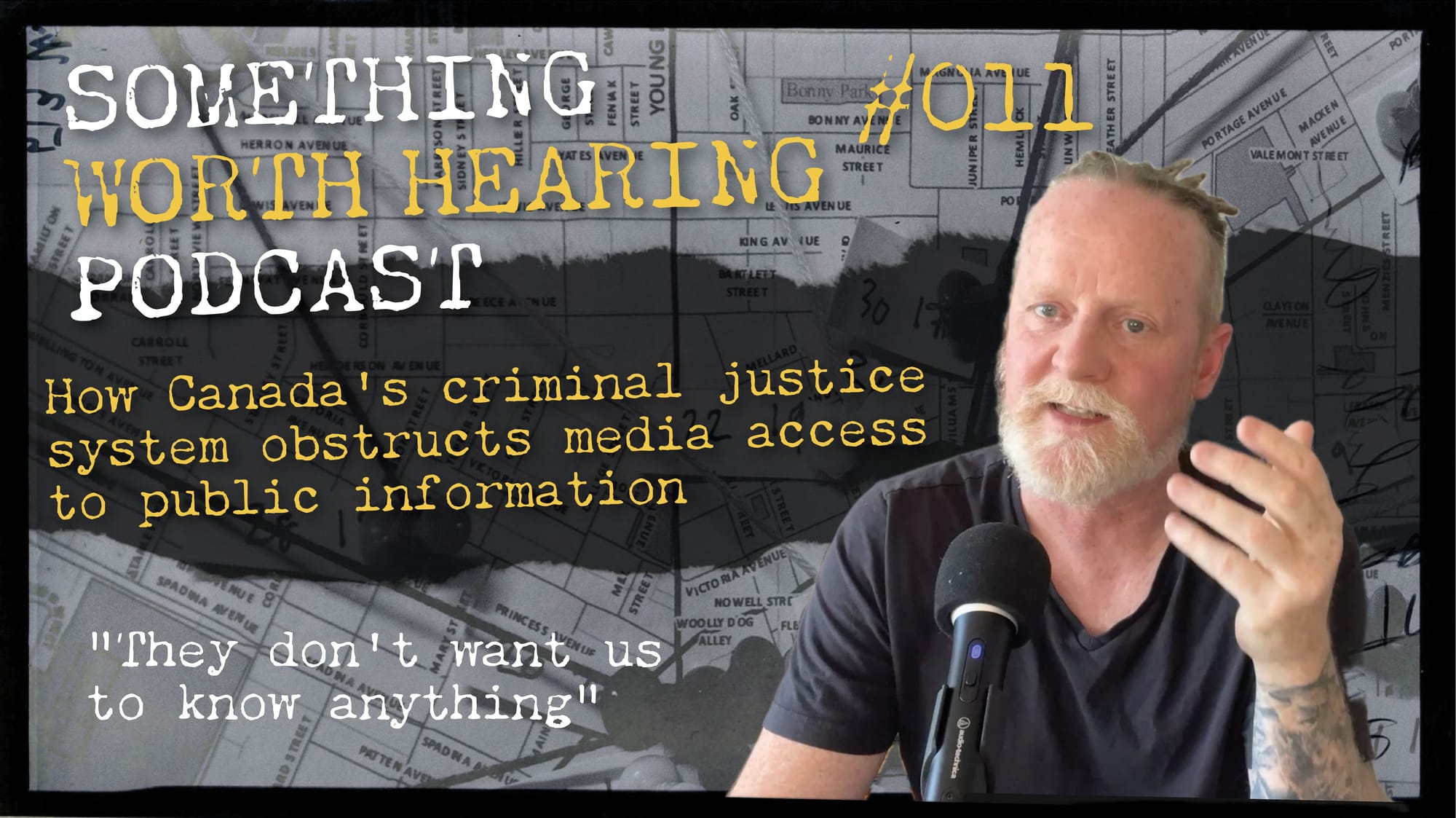
“They don’t want us to know anything,” said a frustrated freelancer.
“We are just a pain in the ass and they don’t want to hear from us,” said an Ontario daily newspaper reporter and columnist with 35 years experience.
A retired journalist who teaches at a Canadian university summed it all up with a tone of exasperation.
“I’m a little depressed listening to what I’ve heard.”
Everyone had specific examples of being denied access to evidence or documents, shut out of virtual hearings or, unbelievably, being told some piece of information can’t be shared because their is a publication ban.
This latter common concern illustrates that some people working in the criminal justice system don’t actually even understand what publication bans are or how they work.
Want to support independent journalism?
Consider a one-time donation or subscribe for less than $1 a week so I can continue this work.
It shouldn’t be who you know
I can’t count the number of times I’ve attended the criminal registry at the Chilliwack Law Courts to ask about a detail on a file to see the interest in helping me akin to a complaints department at a morgue.
Ten or so employees sit at their computers ignoring me as we engage in a game of chicken: them hoping I walk away and give up, me hoping someone will answer my usually very simple questions.
Two common responses I get when I ask court registry staff THE most basic questions about the result of, for example, a BC Supreme Court hearing that I missed:
1. “Why do you want to know?”
My snarky response that I keep to myself: “Because I want to know and it’s public information.”
2. “I can’t tell you about that because there is a publication ban.”
Another unspoken response: “I’ll worry about that. A publication ban is my problem not yours. If it came out in a courtroom or is at all related to a case, you can tell a reporter the information. If they violate the publication ban, which is a criminal code offence, that’s their problem, not yours.”
The thing is, it’s not their fault. They are either ignorant of their democratic requirements because they were never told or they have been directed from some policy on high to treat the public information journalists are asking for as if they are state secrets.
Most are as friendly and as helpful as they think they are allowed to be, but some court registry, sheriffs, judges, Crown and defence lawyers don’t see journalists in courtrooms as conduits to the general public to maintain an essential democratic principle of freedom of expression, they see us as the caricatures of ambulance chasers and paparazzi from Hollywood movies.
One man’s retirement set us all back
To give a concrete example of how public access to what happens in B.C. Supreme Court often relies upon happenstance, the recent retirement of a single man has led to two steps backward for the open-court principle in this province.
One benefit stemming from the pandemic was the ability for participants from lawyers to judges to accused persons to appear remotely, via video or phone. The need for this during the COVID years showed how convenient it was such that it carried over to today. I’ve sat in courtroom 201 in B.C. Supreme Court in Chilliwack for hearings where the only two people physically present in the courtroom were a clerk and me. There is one Crown counsel locally who I have heard from frequently in provincial court who I’ve never once physically seen in a courtroom.
The process I went through for years to gain remote access to Supreme courtrooms was to email the Honourable Bruce Cohen for a dial-in code. The highly respected jurist, maybe best known for being in charge of the eponymous Cohen Commission launched in 2009 into the decline of Fraser River sockeye, spent the last few years of his distinguished career in the much humbler role of Superior Courts Judiciary communications officer.
Getting access was a good system that worked well for me to listen in on courtrooms in Abbotsford. The codes never changed and I had all of them so I hadn’t gotten in touch for a while leading up to May when I emailed him for access to a Chilliwack courtroom I couldn’t get to. I had overlooked an email sent out from the office in March announcing Justice Cohen’s retirement, and heard back from the communications co-ordinator reminding me.
“I will email the judge and send you the details if they approve the dial in,” she wrote me, emphasis mine.
Why is the judge getting involved? And “if they approve,” I thought? I inquired politely what had changed and why I couldn’t have access without involving a judge. I was told this was now the procedure, this despite the fact that Supreme court files are not searchable online, there is no advanced list, so I often only learn about some court appearances the morning of. And the only reason I know of them in advance is because of my obsessive if chaotic system of tracking dozens of cases at the same time.
“These processes are being reviewed, and we will keep all accredited journalists apprised of any changes,” I was told.
It turns out that the policy was always that a judge needed to approve remote court access. We just happen to have a judge in charge of communications. When Cohen retired, that ended.
I told Ontario-based communications expert Alison Crawford about this exchange. Crawford was on that call with journalists across Canada and she was both surprised at what she heard and extremely helpful with possible solutions. You see, she runs a strategic communications company but more relevant to me, she used to be the senior strategic communication advisor to Canada’s Chief Justice at the Supreme Court of Canada. She suggested I request a copy of the B.C. Supreme Court policy that says a judge has to approve court access, although she presumed there really isn’t one.
You see, this should not be up to the whims of individual judges, she pointed out. I played devil’s advocate and humbly suggested that in my experience, judges like to control their courtrooms.
“Yeah, but judicial independence should not apply to who gets access to a remote hearing,” she told me.
Different problems in every province, every courthouse
This all might seem like inside baseball to the general public but sometimes it’s important to understand the process behind the scenes of government, justice and the media. During this Zoom meeting of journalists from across Canada, it was remarkable to hear one after another comment about the hurdles faced.
A B.C. news director said there needs to be education of court staff about what they can and should disclose to us. She said she once got a call from a judge once apologized because she didn’t know that she HAS to let accredited reporters in.
A reporter in New Brunswick said they have no remote access to provincial courts in that province.
A reporter based in St. John’s, Newfoundland said they have provincial access but not Supreme, so if there is a first-degree murder trial in Cornerbrook, that’s a seven-hour drive.
The journalist on the call with probably the most experience having been at it for 35 years said in Ontario some of the judiciary “are outright hostile to the media.”
There isn’t just a patchwork of policies and guidelines for journalists province by province, as many reporters pointed out, it’s different courthouse to courthouse. Saying that there is any policy at all is a stretch as it appears access to court files and courtrooms and all that is needed to tell the public about our criminal justice system is granted based on whims and personalities.
I’ve been doing this for so long that I have a good relationship with the police, sheriffs, most clerks and lawyers, which isn’t just convenient, sometimes that’s the only way I get stories otherwise the public would never know about. I’m literally the only journalist covering the Chilliwack Law Courts regularly, a courthouse that deals with files across an area with a population of approximately 150,000. Other than Vikki Hopes with Black Press in Abbotsford, we are the two only people covering that courthouse as well, the two of which combined see criminal files in an area with upwards of 300,000 people. That area, the Fraser Valley Regional District, which includes the cities of Abbotsford to Hope and all the electoral districts in between is more than 13,000 square kilometres in size, larger than Qatar or Jamaica.
Our system is better than nothing, worse than the U.S.
This all sounds very negative. We do have an open-court system and most days getting access to that system goes relatively smoothly. We are lucky to live in a western democracy where transparency is a basic tenet, at least theoretically.
The problems faced by journalists across Canada are no one person’s problem nor are they the caused by the judiciary or Crown or court registries. As an outside observer look in, it appears the problem is that no one on high is directing staff at courthouses across the country to do their jobs and allow media access to maintain public confidence in the justice system.
If a media lawyer or free-speech advocate who doesn’t already know, could see how opaque our system is, they would be shocked. As would any member of the U.S. media who have exponentially more transparency more access to legal proceedings. One freelance reporter in the meeting who writes about the treatment of incarcerated Muslims and prison conditions pointed out that in the U.S. they have the PACER system (Public Access to Court Electronic Records), which provides information to every court docket and every document in every jurisdiction across the country.
“Its mission,” according to the website’s about us page, “is to provide the public with the broadest possible access to court records and to foster greater public understanding of the court system.”
It’s not free and is in fact fully funded by user fees, but at least it’s there. This is in a country with a population 10 times larger than Canada so it’s not like we couldn’t have this system here it’s because either no one in leadership wants it or has thought much about it.
I end with an example soon after I found out about Justice Cohen’s retirement. It was less than a month ago:
• I emailed at 8:07 a.m. to access courtroom 404 in Abbotsford for 10 a.m. for the case of Frederick Charlie charged with murdering his girlfriend Vanessa Terry at Seabird Island.
• At 9:45 a.m., after a back-and-forth of emails that felt like an Abbott and Costello routine, which I will not bother sharing, one hour and 38 minutes later this missive: “I’ve emailed the judge. If they approve, I’ll send the details.”
• 10:19 a.m. - “The judge is discussing with counsel as there is some sort of pub ban. The judge said he’d get back to me, I’ll keep you posted.”
• 10:35 a.m. – I thanked her, adding: “Respectfully, this doesn't make a whole lot of sense. If I was in Abbotsford – or if any member of the public was – I could walk into the courtroom to listen. Adhering to publication bans is part of my job I've been doing for 20 years.
“Again, respectfully, access and openness is something that is discussed every spring at the media lunch held with senior justices in Vancouver, yet for some reason nothing changes. And this would appear to be a step backwards. I understand this is not in your hands. I assume Mr. Cohen's retirement has thrown a spanner in the works.”
• 10:40 a.m. - “You are absolutely right on all counts. Judge Cohen’s retirement has made things more complicated, and needing permission for something you could attend in person does not make sense to me, either.
“We are looking for ways to streamline this process, especially for accredited journalists like yourself.
“Until then, I can only ask for your continued patience and will let you know if any solutions are approved.”
• By 10:50 a.m., B.C. Supreme Court Justice Shergill, who normally sits in New Westminster, deigned to grant my access to the Abbotsford courtroom asking that I be aware of all publication bans in place.
Thanks. But of course, that came 50 minutes too late.
In a rewarding and essential profession, many of us feel like we’ve been re-arranging deck chairs on the Titanic for two decades so this stumbling block in criminal justice system reporting is a little like adding insult to injury. Reporting on the courts in Canada is often like catching fish with your bare hands. It requires both skill and luck and, if hopefully, a fish that doesn’t mind being caught.
But I’m an optimist, so I will be patient and wait for the day that solutions are approved. For now, I and reporters across the country will keep trying, and do well to heed these words of Maya Angelou: “Do the best you can until you know better. Then when you know better, do better.”
-30-
Want to support independent journalism?
Consider becoming a paid subscriber or make a one-time donation so I can continue this work.
Paul J. Henderson
pauljhenderson@gmail.com
facebook.com/PaulJHendersonJournalist
instagram.com/wordsarehard_pjh
x.com/PeeJayAitch
wordsarehard-pjh.bsky.social