
SLAPP in the face: A look at how some men weaponize defamation law to go after victims & the legislation designed to shut them down
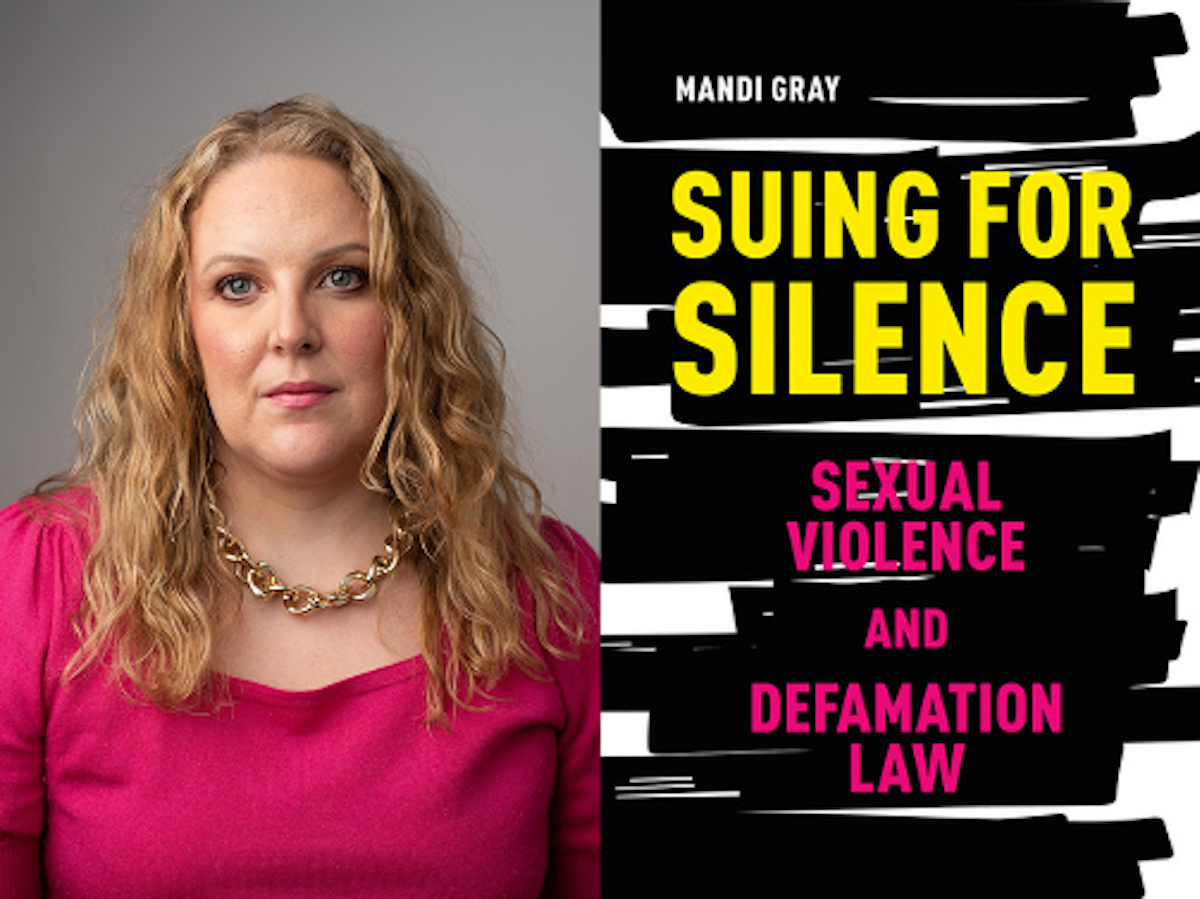
University professor Mandi Gray's book Suing for Silence exposes the phenomena of defamation lawsuits by perpetrators of sexual violence against victims
Choudry Ajlal Mazhar was 26 years old when he met 20-year-old Salwa Farooqi and her family in 2013 while volunteering for an organization called Muslim Awards for Excellence (MAX).
Two years after meeting, Mazhar proposed marriage to Farooqi via Facebook Messenger. She declined.
Three years after that, in June 2018, Mazhar hadn’t dropped the matter. He “returned to the topic of marriage and suggested that he was still waiting for her,” according to an Ontario judge, as quoted in a 2021 Ontario Court of Appeal decision.
In October 2018, Farooqi blocked Mazhar on WhatsApp and asked him not to communicate with her except regarding volunteer activity at MAX.
In December, she became engaged to her long-term partner. A month later, Mazhar sent a lengthy email telling her he had developed a “severe hatred” for her and her mother, negative thoughts he couldn’t control that he attributed to the two of them doing black magic.
“The appellant went on to accuse the respondent’s fiancé of casting a black magic spell on the respondent by feeding her ingredients he had obtained from Bangladesh.”
This email prompted her to confide in the chair of MAX and the board of directors about her concerns. In response, Mazhar filed a defamation lawsuit against Farooqi.
The case, as outlined in UBC professor Mandi Gray’s 2024 book Suing for Silence: Sexual Violence and Defamation Law, illustrates two points: firstly, that the global anti-feminist backlash sparked by the #MeToo movement led to the phenomena of defamation lawsuits by (mostly) men, not as a way to find justice but to silence those who disclose sexual violence in all its forms and intimidate future victims from coming forward.
The case also illustrates the importance of legislation being implemented around the world to stop such vexatious defamation lawsuits before they begin, so-called strategic lawsuits against public participation (SLAPPs), including in Ontario and British Columbia. First created to combat wealthy individuals and corporations from filing frivolous lawsuits against activists to shut them up, these defamation lawsuits were soon seen through a feminist lens. SLAPPs are often used by wealthy (usually) men (usually) to shut up women (usually) in a way that impacts the victims and silences pubic conversation about important sexual violence.
As for the case of Mazhar and Farooqi, she filed an application under Ontario's anti-SLAPP legislation and a judge dismissed Mazhar’s legal action, a decision upheld by the Ontario Court of Appeal.
“The decisions in Rizvee, NG, and Mazhar demonstrate that anti-SLAPP legislation has the potential to protect people who make formal reports of gendered violence to institutional bodies,” Gray writes.
From victim to academic to defendant to author
Gray’s book was the end of a long road after her own experience with sexual violence and her own treatment being sued for defamation. As a first-year PhD student in Toronto in 2015, Gray reported a sexual assault to the Toronto police and the university.
“My experience fuelled my desire to expose the disconnect between what these institutions publicly say will happen when someone reports sexual violence and what actually happens,” she writes in the preface of Suing for Silence.
Two years later, stories of two women in different provinces took her aback. The women were sued by men they had reported for sexual violence, something many thought was impossible.
“I’d asked an expert in the sector about the possibility of being sued,” Gray writes about her own case prior to beginning her advocacy work in 2015. “She assured me that if I’d made a formal report to the police and believed my allegations to be true, I was protected from legal action. This information was only slightly accurate.”
Research such as this, in her capacity as an academic and an anti-violence advocate, was the impetus for the book. Then the topic got personal, again.
On Oct. 29, 2018, Gray read Christie Blatchford’s column in the National Post, an unfortunate way to find out that she and approximately 20 others were named in a defamation lawsuit initiated by author and (now former) University of British Columbia (UBC) professor Steven Galloway. Galloway was accused of sexual impropriety, what exactly hasn’t come out, against a woman A.B. at UBC. This prompted the university to suspend him pending an investigation after which Galloway was fired without severance, a move that turned out to be a mistake. An arbitrator awarded Galloway $167,000 in damages deciding UBC violated his privacy rights causing “irreparable reputational damage and financial loss.”
UBC’s decision was further criticized when more than 80 writers from across Canada, including Margaret Atwood and Michael Ondaatje, published an open letter on a website titled UBC Accountable. There were allegations the investigation lacked due process. On social media it was discussed using the hashtag #UBCAccountable to show support for Galloway. Atwood issued a statement about why she signed the letter comparing Galloway’s treatment to the Salem witch trials.
“This series of events prompted widespread (often hostile) debate on Twitter, to which I contributed,” Gray writes. “I also wrote an op-ed about Atwood’s position.”
That contribution on the topic is how Gray got added to Galloway’s defamation lawsuit. In her book she is careful to skirt the subject to ensure she protects herself from further allegations.
I asked Gray for an interview about about her book in early December. As a faculty member at Trent University in Ontario, she said she was very busy with the last week of classes before the break. I followed up in mid-January but Gray cited a badly broken foot and the fact that she has “my own lawsuit stuff I need to deal with.”
So we didn’t chat. Maybe she doesn't much want to. Maybe, ironically, that makes sense. That was in early 2026, but even two years ago as seen in the preface to her book, the impact of the lawsuit was having a both a psychological but also a chilling effect on her.
“I have tried not to let the ongoing lawsuit impact my writing or research, but if I’m being honest, I made the difficult decision to self-censor, not just because of the lawsuit currently against me but out of fear of future legal action from litigious men,” she writes in the preface of Suing for Silence. “I could not survive another lawsuit, financially or emotionally.”
Whether Galloway is the victim in his own case as suggested by many people or not, Gray’s experience facing a defamation lawsuit for talking about the case at all illustrates the power of civil action against accusers, victims, and third parties.
Rafe Mair said what now?
Anyone in B.C. who paid any attention to the media in the 1990s knows the name Rafe Mair. He was the bombastic shock-jock-style talk show host on CKNW. But he was no mere mook with a mic. The late Mair (1931-2017) was a lawyer and had been a Socred MLA for Kamloops from 1975 to 1981. Mair was one of those guys who ruffled feathers to put it gently, pissed people off to be more accurate. But he was smart and connected enough that people wanted to hear what he had to say.
One way to describe Mair is along the lines of what former U.S. President Richard Nixon once said about investigative journalist Seymour Hersh: “The son of a bitch is a son of a bitch but he’s usually right, isn’t he?”
Mair was also part of a landmark Supreme Court of Canada decision that clarified the defence of fair comment in defamation law in Canada. Mair and his employer were sued by far-right religious activist Kari Simpson after he compared Simpson to Hitler or George Wallace for her anti-LGBTQ rhetoric.
Canadians have a Charter-protected right to freedom of expression, something more limited than American free speech, but the Mair v. Simpson decision broadened the fair comment defence to more closely align it with the freedom of expression values under Section 2 of the Charter.
The Court held that fair comment protects honestly expressed opinions on matters of public interest, even if they are exaggerated, prejudiced, or unreasonable, as long as they are based on known facts and no malice is shown. In short, the ruling strengthened media and public expression protections by reaffirming that robust, even caustic debate on public issues is vital in a free society.
Mair v. Simpson specifically addressed the power of libel chill such lawsuits have on the media when publishers simply self-censor to avoid legal entanglements, even if the topic is of great public importance.
“Chilling debate on matters of legitimate public interest raises issues of inappropriate censorship and self‑censorship,” according to the Supreme Court of Canada decision. “Public controversy can be a rough trade, and the law needs to accommodate its requirements.”
It’s not illegal to be a bit of an asshole while talking about important matters.
All this relates to SLAPPs and the use of legal intimidation to shut down debate on matters of public interest. A current local case before our BC Supreme Court illustrates how these manifestly frivolous and vexatious lawsuits, sometimes do have power to silence and deter specifically, but also generally by creating a culture of fear among potential victims.
Bevin van Liempt is the disgraced former president of the Chilliwack Symphony Orchestra and a music instructor who criminally harassed multiple female teenage students with inappropriate and unabashed romantic entreaties. Both girls unequivocally rejected the 33-year-old but he relented, insisting the rejections via email or text were not actually the girls. It’s their families and other adults around these teenagers manipulating them into rebuffing his advances, he claims.
Even after convictions for criminal harassment and half a dozen breaches of court-ordered conditions, financially and practically backed by his mother Paula De Wit, van Liempt persists. Before he even could be sentenced, he filed notices of civil claim (lawsuits) for defamation against the mothers of the students, the music school and staff from where he was fired prior to the criminal behaviour, two people indirectly related who have watched court proceedings, and yours truly.
The case is a textbook SLAPP and an application has been made by two defendants under B.C.’s anti-SLAPP legislation, the Protection of Public Participation Act, to have the case dismissed. Twice van Liempt has successfully delayed the hearing, precisely as a way to further the intimidation. As Gray’s book puts it, he's pushing the matter off to sue for silence. It’s almost working, as the intentional trauma he inflicts and aggressive harassment continues as he files hundreds of pages of irrelevant documents and non-sensical affidavits and exhibits causing untold torment to some of his victims, not to mention the impact of his social media tirades since his sentencing on March 12, 2026.
Whether his victims will succeed in tossing out these frivolous lawsuits is not yet known. Given how long it has taken Gray to deal with the lawsuit where she is a co-defendant, it could be a long way yet.
What’s clear in all these cases, however, is that the intimidation of victims and other vulnerable people by perpetrators who weaponize the legal system to silence critics needs to be curtailed.
B.C.’s PPPA might be the answer. Time will tell.
To purchase a paperback or ebook copy of Suing for Silence: Sexual Violence and Defamation Law by Mandi Gray published by UBC Press, visit www.ubcpress.ca/suing-for-silence
-30-
Want to support independent journalism?
Consider becoming a paid subscriber or make a one-time donation so I can continue this work.
Paul J. Henderson
pauljhenderson@gmail.com
facebook.com/PaulJHendersonJournalist
instagram.com/wordsarehard_pjh
x.com/PeeJayAitch
wordsarehard-pjh.bsky.social