First Nations boy defiant as Fraser Valley school orders him to stop wearing cedar hat & sacred eagle feather
Hunter Joe, 14, says he’s trying to respect tradition not be difficult, as support flows in from local First Nations leaders and a UBC professor
When Grade 8 student Hunter Joe was told to take off his hat in an Agassiz Elementary-Secondary School class recently, the teacher and school principal likely didn’t know they were poking a bear.
Even after being told how significant the cedar-weaved hat is to his culture and how sacred an eagle feather is to First Nations people, Principal Greg Lawley didn’t back down, according to Hunter’s mother Desiree Peters.
Now, the 14-year-old has the support of a University of British Columbia (UBC) professor who is encouraging the school to support the boy’s expression of cultural identity, something that aligns with all school districts’ reconciliation commitments, not to mention UNDRIP, DRIPA, and the Truth and Reconciliation Commission’s calls to action.
Hunter Joe was given an eagle feather as a baby, a deeply sacred First Nations symbol of honour, strength and wisdom. His mother is an expert maker of cedar hats, of harvesting cedar bark, and she tours the province teaching others the art form.
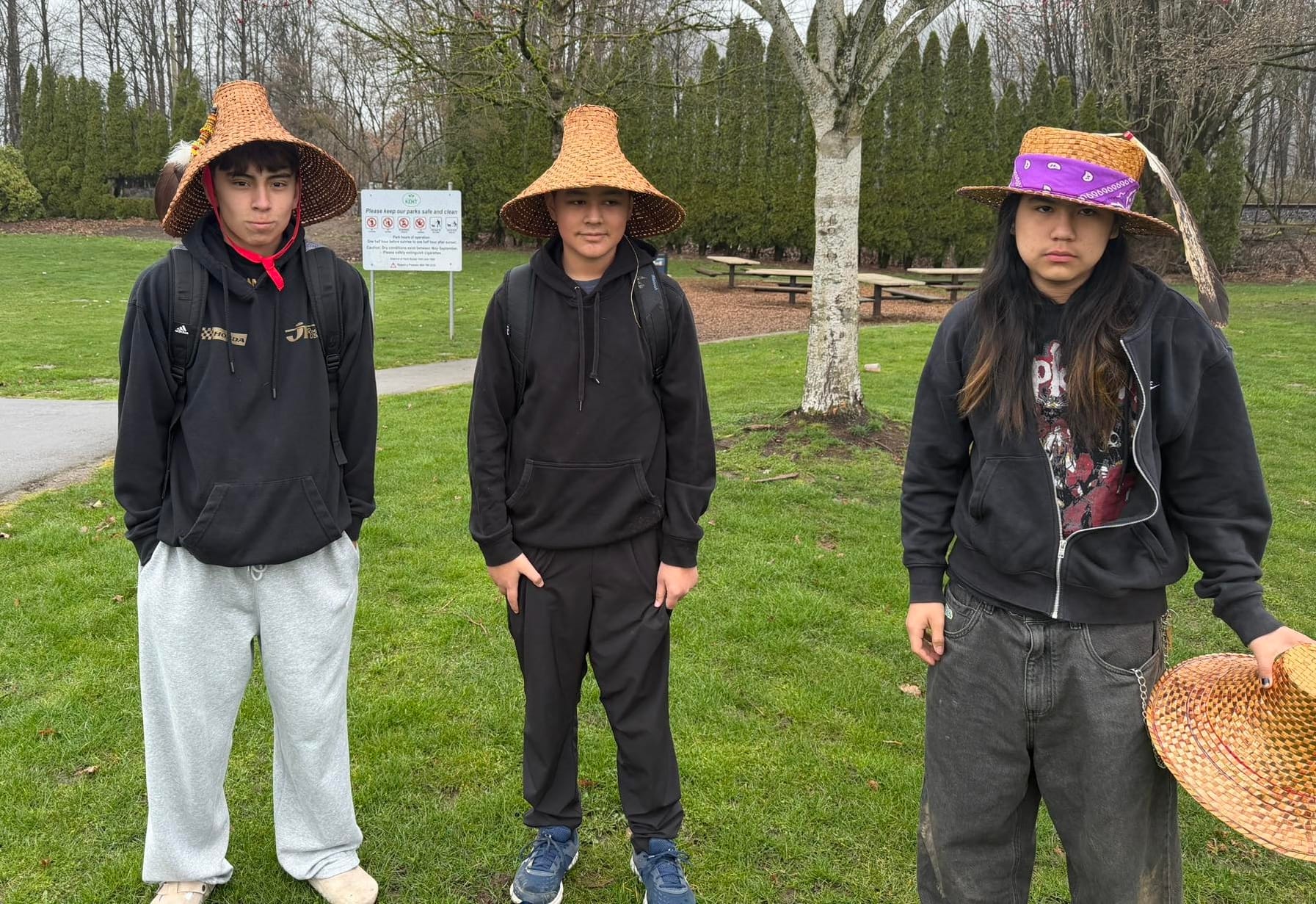
Last spring, the then 13-year-old Hunter told his mother he wanted a cedar hat.
“I told him he had to earn it,” Peters said. “So we took him out harvesting cedar and taught him the traditional ways to harvest bark.”
Peters’ fiancé Thomas told Hunter that if the boy came out, learned how to do it properly, Thomas would make him a hat, and he did. The hat was finished in February and given it to Hunter as a late birthday present.
“Hunter is really proud of his hat,” Peters said. “He started wearing it to school.”
The problem is that the school has a blanket no-hat policy. Most teachers apparently didn’t mind Hunter’s cedar hat, but science teacher Mr. Singh told him to take it off. Hunter pushed back then and he’s not backing down.
“I’m not trying to start shit,” Peters told me. “I’m actively trying to get Hunter to chill out, and he’s like, ‘No. I’m not going to let somebody dictate whether I can wear a hat with a feather in my territory.’”
Peters said she wishes Hunter didn’t want to fight this battle, but he comes from a long line of traditional First Nations leaders, and the eagle feather given to him is his alone. Peters’ parents both went to St. Mary’s Residential School, and the family are descendants of Chief Coquitlam Williams and respected weavers Lena Hope and Rosie Charlie of Yale. His uncles include Chief Don Harris of Xa’xtsa (Douglas First Nation) and Chief James Harris of Seabird Island. His family lineage also includes Chief Alfred Hope and Grand Chief Vincent Harris, who is Hunter’s great-grandfather.
In short, he’s not trying to stir up trouble as some teenagers sometimes do. This is his culture.
“If he went to school with something like a Playboy hat or a middle finger or something radical like, I hate to say it, an AIM (American Indian Movement) hat, I would have been like, ‘no, I’m a mom and I’m going to put a stop to this,’” Peters said. “Some stuff you just don’t bring to school. This is a plain cedar hat with a feather on it and a bandana. And he’s right about the tradition.”
The eagle feather is so significant and sacred, last year the BC RCMP adopted the “eagle feather protocol,” which allows victims, witnesses, suspects, and police officers to swear legal oaths on an eagle feather the same way others use a Bible or make an affirmation.
Hunter first wore the hat on Monday, Feb. 23. It was Thursday when he was told by Mr. Singh to take it off. His Sts’ailes friend Zane Carter stood up for Hunter arguing with the teacher about the cultural significance. They were sent to the principal’s office and then they walked out of school.
Hunter may not have noticed the irony that First Nations people were originally called “Indians” and that the teacher who told him to take his hat off is of Indian descent, but the boy did see what appeared to be an element of hypocrisy.
“Hunter is said, ‘If there's hat rule in the school, why is he wearing a turban?’”
Peters said the vice-principal told Hunter his cedar hat does not have the same cultural significance as a turban to a Sikh, but that only frustrated him more, making him feel as if he and his culture were being treated as lesser.
Given the cultural fight that has gone on relatively recently in Canada for Sikhs to be allowed to wear turbans in various places previously not allowed, such as military service, Peters is surprised Mr. Singh isn’t one teacher who might understand where Hunter is coming from.
Peters said even Christine Seymour, the school district’s principal of Indigenous Education, wants Hunter to just stop wearing the hat, and Hunter is holding his ground.
“I've tried to meet 50/50 with Hunter and the principal, but Hunter won't budge and the principal won't budge.”
She said the situation has Hunter feeling defeated, but they are getting broad support from First Nations leaders given their family connections, but even from Indigenous academia.
Rosalin Miles (PhD) is a member of the Lytton First Nation, a UBC research associate and a Canadian Institutes for Health Research scientific chair in human development and child and youth health at the University of British Columbia.
On Monday morning (March 9, 2026), Miles wrote a lengthy email to Principal Greg Lawley and to Mr. Singh, also copying Christine Seymour.
“I am writing to express my support for Hunter Joe, a First Nations student attending Agassiz Elementary Secondary School, and to respectfully advocate for his right to wear a cedar hat as an expression of his cultural identity and family teachings,” Miles wrote, pointing out that Fraser Cascade School District is in an Indigenous Education Enhancement Agreement in partnership with local First Nations, including Seabird Island, Cheam, Sts’ailes, Yale and others. This means the district has a responsibility to honour and support Indigenous history, and ensure students feel safe and respected.
Then there is the United Nations Declaration on the Rights of Indigenous Peoples aligned to with B.C.’s Declaration on the Rights of Indigenous Peoples Act. Miles also referenced the Truth and Reconciliation Commission’s calls to action.
“Within this context, the situation involving Hunter Joe raises significant concern,” Miles wrote. “Hunter wishes to wear a cedar hat that reflects the cultural teachings and identity shared with him by his family. Cedar is deeply sacred within many Coast Salish communities and represents protection, strength, and connection to land and ancestors. For many Indigenous families, cedar is not simply a material but a living symbol of culture, responsibility, and belonging.”
As First Nations people know (and most of the rest of us should have learned), for generations Indigenous children were forced to remove visible expressions of their culture within schools that attempted to erase Indigenous identity, language, and traditions.
“Education systems across Canada are now working to repair this history by ensuring Indigenous students feel respected and safe to bring their full identity into the classroom. When a student is asked to remove a cultural item such as a cedar hat, it can echo those earlier experiences of exclusion and cultural suppression that reconciliation efforts seek to address. My father and our relatives attended Indian Residential schools, and we know the harm this did to our ancestors.”
Even stronger, Miles tells the principal and the teacher that ordering Hunter to remove his cedar hat raises serious concerns about cultural safety and sends a “troubling message” to the community.
“I respectfully encourage the school to support Hunter Joe in wearing his cedar hat as an expression of cultural identity and belonging. “
As for Hunter, he didn’t go to school on Monday (March 9), although he did wear the hat the previous week. He told his mother he is willing to get kicked out of school over this.
It is possible the principal and district will back down, maybe make this a teachable moment, given the Hunter’s principled and logical response along with the strong support of local First Nations leaders, and a lengthy missive from a UBC professor.
When first asked about the situation, Peters said she acknowledges the school district has a no-hat policy with the same respect as the school district issues land acknowledgements.
-30-
Want to support independent journalism?
Consider becoming a paid subscriber or make a one-time donation so I can continue this work.
Paul J. Henderson
pauljhenderson@gmail.com
facebook.com/PaulJHendersonJournalist
instagram.com/wordsarehard_pjh
x.com/PeeJayAitch
wordsarehard-pjh.bsky.social